
Affiliate Disclosure: If this guide mentions products, we may earn a commission. If you buy through them, we may earn a commission at no extra cost to you. Learn more.
How to read a supplement label is one of the most useful skills for anyone researching wellness products — pick up almost any bottle and you’ll find numbers, percentages and unfamiliar terms. This guide walks through each part of a typical supplement label in plain language.
The Supplement Facts Panel
The “Supplement Facts” box — similar to the “Nutrition Facts” box on foods — is the most important part of the label. It lists serving size, nutrients and their amounts, and the % Daily Value for each. Everything else on the label is secondary to this panel.
Supplement Labels: Serving Size and Servings Per Container
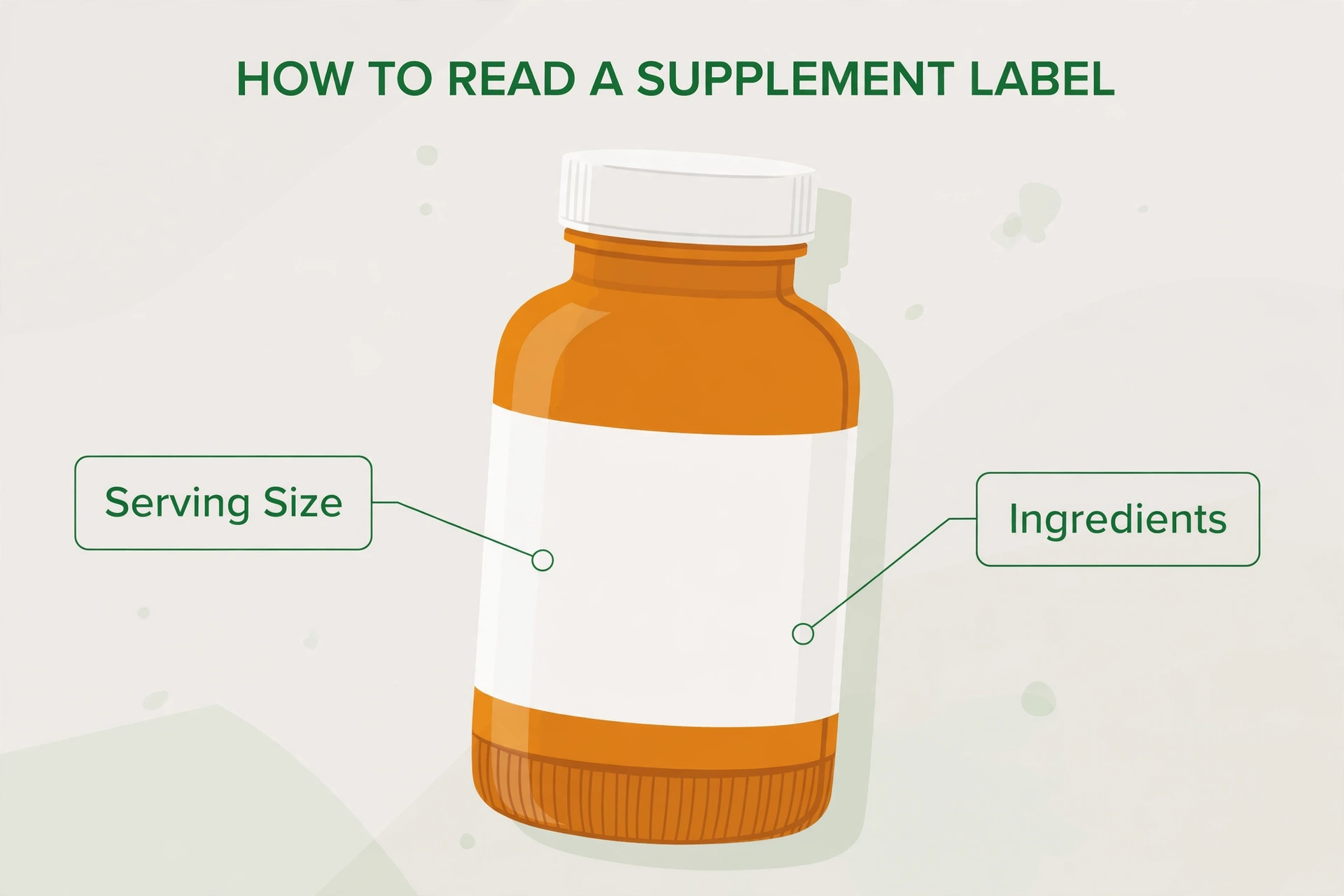
Start at the top. “Serving size” tells you the amount the rest of the numbers refer to — for example, 2 capsules. “Servings per container” tells you how many of those servings the bottle holds. If the serving size is 2 capsules and you take 1, you are getting half of every amount listed.
Supplement Labels: Ingredients: What the Order Means
Ingredients are generally listed in descending order of weight. The first few ingredients make up most of the product; the last ones are present in the smallest amounts. A “proprietary blend” groups several ingredients under one total amount without showing each one individually — this makes it harder to know exactly how much of each ingredient you are getting.
Supplement Labels: % Daily Value Explained
The % Daily Value (%DV) shows how much of a nutrient one serving provides relative to a daily reference amount. As a rough rule: 5% DV or less is low, 20% DV or more is high. Note that daily values are general references, not personal recommendations — your needs may differ.
Supplement Labels: Claims on the Front of the Bottle
Front labels often carry short claims like “supports immunity” or “high potency”. These are marketing statements, not guarantees. The Supplement Facts panel and ingredient list are far more informative than the front of the bottle.
Supplement Labels: Red Flags to Watch For
- No Supplement Facts panel or a missing ingredient list.
- “Proprietary blend” with no individual amounts for key ingredients.
- Disease claims such as “cures” or “treats” — supplements are not approved to cure diseases.
- No manufacturer contact information or no way to verify the company.
Supplement Labels: Third-Party Testing Seals Worth Knowing
Anyone can print “high quality” on a bottle. Third-party seals mean an outside lab actually checked. Here’s what the common ones tell you.
USP Verified. The U.S. Pharmacopeia tests that the product contains what the label claims, in the stated amounts, and breaks down properly in your body. It’s one of the strictest seals in the industry.
NSF Certified. NSF International checks label accuracy and screens for contaminants like heavy metals. Their “Certified for Sport” version goes further, testing for banned athletic substances.
Informed Choice / Informed Sport. Similar to NSF’s sport certification — focused on making sure products are free of banned substances. Athletes subject to drug testing look for this one.
ConsumerLab. An independent company that buys products off shelves and tests them. They publish pass/fail results. A product can’t just pay for a passing grade — ConsumerLab chooses what to test.
No seal guarantees a product works. Seals speak to quality control, not effectiveness. But when two similar products compete, the one with independent testing earns more trust.
Supplement Labels: Proprietary Blends — What They Hide
A proprietary blend lists several ingredients under one total amount. You see the blend weighs 500 mg, but you don’t know if that’s 490 mg of the cheap ingredient and 10 mg of the expensive one.
Companies use blends to protect formulas from competitors. That’s the charitable explanation. The less charitable one: blends let sellers sprinkle tiny “fairy dust” amounts of trendy ingredients while leaning on cheaper fillers.
Here’s a practical rule. If an ingredient matters to you, look for its individual amount on the label. No amount listed means you can’t judge whether the dose is meaningful. Research studies use specific doses — a blend that hides doses can’t be compared to that research.
Blends aren’t automatically bad. Some legitimate products use them. But they shift the burden to you: without transparent amounts, you’re trusting the company’s word instead of verifying the math yourself.
Supplement Labels: Expiration Dates, Lot Numbers, and Storage
Check the expiration or “best by” date before buying, especially online. Supplements lose potency over time. A bottle expiring next month isn’t a bargain — it’s a countdown.
Look for a lot or batch number printed on the bottle. Reputable manufacturers track production by lot, which matters if there’s ever a recall. No lot number suggests sloppy quality control.
Storage instructions exist for a reason. Heat, light, and moisture degrade many ingredients. That cabinet above your stove? One of the worst spots in the house. A cool, dry shelf beats a steamy bathroom every time.
Probiotics and fish oil deserve extra attention. Both break down faster than most supplements when stored poorly. If the label says “refrigerate after opening,” take it seriously — room-temperature probiotics may be dead on arrival.
Supplement Labels Frequently Asked Questions
What is the difference between “Supplement Facts” and the ingredient list?
The Supplement Facts panel shows dietary ingredients with amounts and % Daily Values. A separate “other ingredients” list usually covers fillers, binders and capsule materials.
Supplement Labels: Does a longer ingredient list mean a better product?
Not necessarily. More ingredients can mean smaller amounts of each. Focus on whether the ingredients you care about are present in meaningful amounts.
Supplement Labels: Should I trust “natural” on the label?
“Natural” is a marketing term with no strict legal definition for supplements. Check the actual ingredient list instead of relying on front-label words.
Disclaimer: This guide is for general information only and is not medical advice. Consult a qualified health professional before starting any supplement. See our Medical Disclaimer.
Supplement Labels: Keep Reading on HealthVerz
Related reviews and guides from our research library — the context that helps you judge any health product more clearly.
NeuroPrime Review
Put your label skills to work — brain drops with a full ingredient panel.
Sugar Defender Review
Liquid blood-sugar drops — check the label against our breakdown.
LeanBiome Review
Probiotic weight-loss capsules — ingredients decoded in our review.